
Case Library
The Harvard Chan Case Library is a collection of teaching cases with a public health focus, written by Harvard Chan faculty, case writers, and students, or in collaboration with other institutions and initiatives.
Use the filters at right to search the case library by subject, geography, health condition, and representation of diversity and identity to find cases to fit your teaching needs. Or browse the case collections below for our newest cases, cases available for free download, or cases with a focus on diversity.
Access to cases
Many of our cases are available for sale through Harvard Business Publishing in the Harvard T.H. Chan case collection. Others are free to download through this website.
Cases in this collection may be used free of charge by Harvard Chan course instructors in their teaching. Contact Allison Bodznick, Harvard Chan Case Library administrator, for access.
Access to teaching notes
Teaching notes are available as supporting material to many of the cases in the Harvard Chan Case Library. Teaching notes provide an overview of the case and suggested discussion questions, as well as a roadmap for using the case in the classroom.
Access to teaching notes is limited to course instructors only.
- Teaching notes for cases available through Harvard Business Publishing may be downloaded after registering for an Educator account.
- To request teaching notes for cases that are available for free through this website, look for the “Teaching note available for faculty/instructors” link accompanying the abstract for the case you are interested in; you’ll be asked to complete a brief survey verifying your affiliation as an instructor.
Using the Harvard Business Publishing site
Faculty and instructors with university affiliations can register for Educator access on the Harvard Business Publishing website, where many of our cases are available. An Educator account provides access to teaching notes, full-text review copies of cases, and discounted pricing for your students.
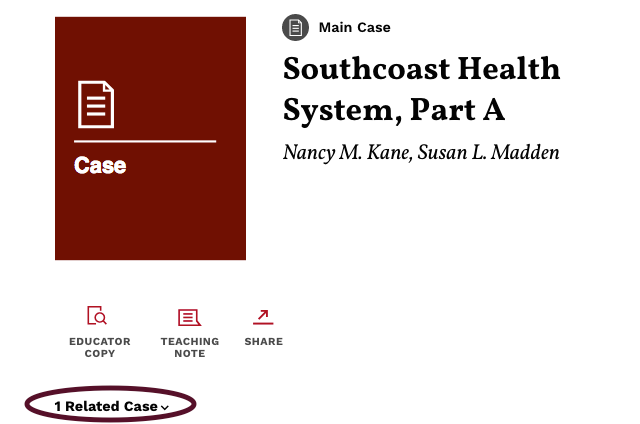
Looking for part “B” or “C” of a case? Click on “Related Case,” circled below:
What’s New
Abstract
This case study centers on Tan Tock Seng Hospital (TTSH), an acute care hospital in Singapore and a major provider within the National Healthcare Group (NHG). The case invites students to assume the role of CEO of TTSH and formulate recommendations to implement a high-value solution in Singapore, supporting a transition to the Harvard High-Value Health System Model (HVHS). The narrative unfolds in three phases: Phase 1: IHFCP Initiative (2010-2016): The case begins with the Integrated Hip Fracture Care Pathway (IHFCP) initiative, pioneered by Professor Eugene Fidelis Soh. This program sought to optimize hip fracture care within TTSH by implementing an integrated care pathway, necessitating other HVHS components such as outcome measurement and integrated provider networks. The initial phase focused on improving patient outcomes and streamlining care delivery for hip fractures. Phase 2: IHFCP Expansion (2017-2022): The focus shifts to promoting sustainability and value in Singapore's health system. A key turning point occurs when the MOH commissions IHFCP as part of its Value-Driven Care initiative. The IHFCP refines its value creation framework, introduces new HVHS components (cost measurement systems, value-based payments, and integrated provider networks) emphasizing value for payers, providers, and patients. Phase 3: Refining and Sustaining the Solution (2022 and Beyond): The final phase explores challenges, such as refining targets, translating outputs to better outcomes, and enabling clinicians. The approach shifts from optimizing care to preemptive strategies to prevent hip fractures, aligning with NHG's 'River of Life' and the MoH's '3 Beyonds' strategy to emphasize prevention, holistic care, and cost-effectiveness. In summary, this case study examines TTSH's journey and invites students to engage in strategic thinking that bridges theory and practice, contributing to health system transformation and the HVHS transition.
Abstract
In 2017, Portugal's health system faced a substantial challenge due to fiscal constraints from the 2011 economic crisis and the austerity measures that followed, reducing fiscal space for health. Health Cluster Portugal (HCP), a non-profit association, recognized the urgent need to pivot towards high-value solutions to respond more sustainably to the system's inefficiencies and inequities. HCP decided to focus on cataract surgery to develop its first high-value solution. The Value Based Cataract Surgery Initiative (VBHCAT) was spearheaded to enhance efficiency, effectiveness, equity, and responsiveness in cataract surgery. The initiative aimed to involve both public and private hospitals, utilizing digital tools for data collection and analysis. VBHCAT focused on outcome measurement systems and analytics to drive improvements in the care pathway for cataract surgery. Implementing VBHCAT faced substantial challenges. First, the public and private hospitals involved used different electronic medical record (EMR) systems, presenting a data collection hurdle. Second, ensuring clinician receptivity and engagement was another crucial factor. Third, sustained political support from the Ministry of Health was essential, particularly in the context of several changes in political administration that could affect policy priorities and the initiative's sustainability. Looking to the future, HCP planned to expand VBHCAT's scope by adding cost measurement systems and progressing towards value-based payment models. The possibility of extending the high-value solution to other conditions or surgical services was also considered, though the feasibility of such expansion remained a subject for discussion.
Abstract
Sehat Kahani's evolution into a transformative venture in Pakistan's digital health sector illustrates a strategic response to health system challenges, marked by three phases aimed at creating value and enhanced system-level outcomes. 1) Inception and Early Development: Founded by Drs. Iffat Zafar and Sara Khurram, Sehat Kahani began as a response to two issues: the lack of accessible high-value healthcare for marginalized communities and the underutilization of female medical professionals. With an initial $25,000 venture prize, they established two eHealth clinics which delivered primary care via a digital platform while re-integrating female doctors into the workforce. 2) Pivot and Expansion: Recognizing limitations in the model's revenue generation, Sehat Kahani pivoted in 2019 to develop a mobile app. The app initially focused on mental health services for corporate employees and expanded to offer a range of services through telemedicine and revenue cycle management. The COVID-19 pandemic accelerated this shift, with over 100,000 consultations provided via new initiatives like free consultations and a COVID-19 helpline. A partnership with the UNDP and Ministry of National Health Services enabled the upgrade of 60 ICUs into Tele-ICUs, showcasing scalability and adaptability in crises. 3) Plans for Future Growth and Internationalization: Sehat Kahani is aiming for further expansion. Plans include refining and integrating service offerings into a cohesive app, extending the clinic network, forming more government partnerships, and expanding private clients. International growth will begin in the Middle East, leveraging competitive pricing and a comprehensive service model, despite facing new competitive landscapes. Strategic financing will be crucial for these efforts. Sehat Kahani's journey from concept to digital health leader highlights the transformative power of technology in bridging disparities, adaptability, and scalability in health systems.
Abstract
In September 2025, Yasser Joharji, CEO of Nahdi Medical Company, Saudi Arabia's pharmacy and emerging digital health giant, is finalizing a five-year strategy for OmniHealth, Nahdi's omnichannel health platform that blends the nation's largest pharmacy chain, fast-growing clinics, homegrown telemedicine, and a robust digital loyalty infrastructure. Nahdi's business has thrived through scale, operational excellence, analytics, and early digitalization. Yet with competition rising, traditional rivals scaling up, digital startups advancing, and global players arriving, Joharji must define OmniHealth's future: How should OmniHealth's brand and platform be positioned in a crowded marketplace for uniqueness and defensibility, particularly in a landscape now shaped by digital and AI advances? Which digital and AI capabilities will sustain Nahdi's edge as it moves towards proactive health services and precision health and potentially toward population-level offerings? Which growth path (further Saudi/regional scale, digital/AI-driven personalized care, or a leap into population health/analytics) should Nahdi, and OmniHealth, pursue?
Abstract
This case study centers on Southlake Regional Health Centre (Southlake) in Ontario, Canada, as it embarks on a journey toward value-based procurement (VBP). Robert Bull, Vice President of Finance, Technology & Innovation, sees an opportunity to transform Southlake's traditional procurement process into one that generates value by improving health outcomes while managing departmental costs. Facing rising costs, inefficiencies, and declining satisfaction, Ontario implemented initiatives to enhance healthcare quality, accountability, and resource management and encourage innovation and strategic procurement. Bull initiated the VBP process by engaging physicians in the Cardiac Program to define and measure value, focusing on four dimensions: (I) economic benefits, (II) innovation, (III) operational improvements, and (IV) patient outcomes. Collaboration between physicians and vendors enabled the development of innovative solutions to enhance value, such as exploring dual-chamber pacemakers for improved outcomes and cost reduction. Southlake's procurement team introduced a clinician dialogue process to connect purchased products with achieved outcomes, developing quality performance indicators (QPIs) aligned with these outcomes. A collaborative scoring matrix was created to assess vendors based on performance across 12 QPIs and proposed value-added solutions. The case describes a competitive dialogue process, with phases for planning, onboarding vendors, active dialogue, and post-dialogue engagement, ensuring fairness and transparency. This structured-yet-flexible approach fostered collaboration and co-development of innovations between Southlake and vendors. By engaging physicians and vendors, defining value dimensions, and implementing a competitive dialogue process, Southlake began demonstrating improved patient outcomes and delivering value to stakeholders.
Cases Available for Free Download
Abstract
In August of 2020, after a day treating patients, John McAdams, MD, gets ready to meet with a young couple from the community. He is excited to share the latest progress on his institution’s Cancer Treatment and Control Center, which is set to open in 3 years. The $230+ million project is something that Dr. McAdams has been building in his mind for years. Its brick and mortar location will strive to be a truly different cancer center that emphasizes population health alongside acute treatment. Cutting edge technologies and innovative public health initiatives working in tandem will close the gap between rural and urban cancer patient outcomes.
After decades of diligence, vision, and advocacy from John, Midwest Regional Health (MRH) has purchased the physical location of what will be a state-of-the-art cancer treatment and control center—a rarity for rural America. The site is on the main campus and will be connected to the inpatient and pediatric hospitals by tunnels to have the cancer center be better integrated into the continuum of cancer care than an outpatient center at a separate location. According to John, “The architects have worked very hard to make the center what we wanted…very welcoming and reassuring but intertwining all the workings of the various departments.”
However, with just three years before the grand opening, questions remain about how to structure the management of the cancer center relative to the medical center and the oncology service line, how to expand the research base in oncology, and how to drum up excitement and support in the community.
Abstract
The case recounts the events of the 2014-2016 West Africa Ebola Outbreak, starting with the death of patient zero, a young Guinean boy named Emile Ouamouno in December 2013 and ending in August 2014 when the World Health Organization declared the outbreak a Public Health Emergency of International Concern (PHEIC), an international legal tool aimed to draw additional attention and resources to particular health events which present a global risk. In doing so, the case particularly examines the role of the World Health Organization, a key actor in the epidemic, and provides further context into the strategy, finances, and organizational design of the organization. Additional information related to the Ebola Virus Disease (EVD), infectious disease epidemics, and the socioeconomic and political context of the three countries most affected by the outbreak (Sierra Leone, Liberia, and Guinea) is also provided. The case study draws upon interviews with key experts involved in both the management of the epidemic and its aftermath, including Dr. Suerie Moon, Study Director of the Independent Panel on the Global Response to Ebola, Amb. Jimmy Kolker, then Assistant Secretary for Global Affairs in the United States Department of Health and Human Services, and Dr. Bruce Aylward, Special Representative of the Director-General for the Ebola Response from September 2014 to July 2016.
The case is accompanied by an epilogue which retraces events after the PHEIC was declared in August 2014, and provides several quotes from key stakeholders involved in the outbreak, providing further context into how the epidemic was eventually contained, and which lessons could be learned from it.
Abstract
This case is located within the multinational pharmaceutical company Novartis, as key managers decide what kind of monitoring and evaluation to implement for one of its social business programs, Novartis Access. This new program will expand the company’s reach into traditionally underserved markets in low- and middle-income countries using a basket of 15 medicines for non-communicable diseases offering them at public and faith-based facilities at a lower price than sold in the private market. Novartis Access is being launched in late 2015 in Kenya, with a long-term goal of operating in 30 countries. The case focuses on Michael Fürst, Senior Manager for Corporate Responsibility Strategy and Innovation, who must prepare a plan for monitoring and evaluation for Novartis Access to present to Harald Nusser, Head of Novartis Social Business. In order to prepare for his first meeting with Harald Nusser, Michael Fürst needs to identify the value and risks of monitoring and evaluating (and their differences) and make a proposal about what kind of monitoring and evaluation to adopt (if any), and how to overcome internal and external challenges.
Abstract
Elizabeth, a middle-aged African American woman living in Minnesota, develops chest pain and eventually presents to a local emergency room, where she is diagnosed with stress-related pain and given Vicodin. Members of a non-profit wellness center where she is also seen reflect on the connection between her acute chest pain and underlying stress related to her socioeconomic status. On a larger level, how much of her health is created or controlled by the healthcare system? What non-medical policy decisions impacted Elizabeth such that she is being treated with Vicodin for stress?
Abstract
In 2011 in response to two high profile cases of maternal death during labor and delivery, Ugandan citizens mobilized to prevent maternal mortality by improving the delivery of healthcare services in public hospitals. The Coalition to Stop Maternal Mortality ignited a social movement by utilizing strategic advocacy to hold the Government of Uganda accountable to its constitutional provisions on health service delivery. This case examines the Coalition to Stop Maternal Mortality and its landmark legal initiative, Constitutional Petition No. 16 of 2011, that focused the nation’s attention on the state of health services in Uganda and initiated a nationwide conversation about the role of government in delivering the right to health for all Ugandans. What tactics and strategies can effectively mobilize power to bring about legal and policy change? Would these be enough to achieve the change that the Coalition sought?
Focus on Diverse Protagonists and Communities
Abstract
This case describes the development and growth of the Cincinnati Child Health-Law Partnership (Child HeLP), a medical-legal partnership founded in 2008 by Cincinnati Children's Hospital and the Legal Aid Society of Greater Cincinnati. Medical-legal partnerships (MLPs) involve collaboration between healthcare organizations and legal advocates to address the social and structural conditions that shape health, such as eviction, substandard housing, and barriers to public benefits. Child HeLP began by providing individual referrals from pediatric primary care clinics but soon uncovered systemic housing issues that affected dozens of children across entire neighborhoods. Over the next fifteen years, the partnership grew into one of the most established MLPs in the country, serving roughly 800 families annually, achieving high-profile legal victories, reducing hospitalizations for referred children, and expanding into specialty care.
By late 2022, demand had surged to more than 1,000 referrals each year, while funding and staffing remained largely unchanged. Co-founders Dr. Robert Kahn and Elaine Fink faced a strategic crossroads: they had to facilitate Child HeLP's continued growth, protect staff already stretched thin, and build the infrastructure required to sustain the program long after their direct involvement. The case highlights questions of organizational resilience, growth, and leadership succession in the face of rising demand and constrained resources. The case can be used to help students explore the challenges of building cross-sector partnerships, understand novel interventions addressing social and structural determinants of health, and learn how leaders balance short-term constraints with long-term strategy.
Abstract
This case describes efforts to promote racial equity in healthcare financing from the perspective of one public health organization, Community Care Cooperative (C3). C3 is a Medicaid Accountable Care Organization–i.e., an organization set up to manage payment from Medicaid, a public health insurance option for low-income people. The case describes C3’s approach to addressing racial equity from two vantage points: first, its programmatic efforts to channel financing into community health centers that serve large proportions of Black, Indigenous, People of Color (BIPOC), and second, its efforts to address racial equity within its own internal operations (e.g., through altering hiring and promotion processes). The case can be used to help students understand structural issues pertaining to race in healthcare delivery and financing, to introduce students to the basics of payment systems in healthcare, and/or to highlight how organizations can work internally to address racial equity.
Abstract
The case describes the challenges facing Shlomit Schaal, MD, PhD, the newly appointed Chair of UMass Memorial Health Care’s Department of Ophthalmology. Dr. Schaal had come to UMass in Worcester, Massachusetts, in the summer of 2016 from the University of Louisville (KY) where she had a thriving clinical practice and active research lab, and was Director of the Retina Service. Before applying for the Chair position at UMass she had some initial concerns about the position but became fascinated by the opportunities it offered to grow a service that had historically been among the smallest and weakest programs in the UMass system and had experienced a rapid turnover in Chairs over the past few years. She also was excited to become one of a very small number of female Chairs of ophthalmology programs in the country.
Dr. Schaal began her new position with ambitious plans and her usual high level of energy, but immediately ran into resistance from the faculty and staff of the department. The case explores the steps she took, including implementing a LEAN approach in the department, and the leadership approaches she used to overcome that resistance and build support for the changes needed to grow and improve ophthalmology services at the medical center.
Abstract
For more than 30 years, Dr. Joan Reede worked to increase the diversity of voices and viewpoints heard at Harvard Medical School (HMS) and at its affiliate teaching hospitals and institutes. Reede, HMS’s inaugural dean for Diversity and Community Partnership, as well as a professor and physician, conceived and launched more than 20 programs to improve the recruitment, retention, and promotion of individuals from racial and ethnic groups historically underrepresented in medicine (UiMs). These efforts have substantially diversified physician faculty at HMS and built pipelines for UiM talent into academic medicine and biosciences. Reede helped embed the promotion of diversity, equity, and inclusion (DEI) not only into Harvard Medical School’s mission and community values, but also into the DEI agenda in academic medicine nationally. To do so, she found allies and formed enduring coalitions based on shared ownership. She bootstrapped and hustled for resources when few readily existed. And she persuaded skeptics by building programs using data-driven approaches. She also overcame discriminatory behaviors and other obstacles synonymous with being Black and female in American society. Strong core values and sense of purpose were keys to her resilience, as well as to her leadership in the ongoing effort to give historically marginalized groups greater voice in medicine and science.
Abstract
This case explores the challenges facing a new Chief Human Resources Officer as she evaluates health insurance benefits at a financial services company with 100,000 employees. Bank4 faces increasing costs while its employees see rising out-of-pocket expenses. Students will participate in workgroups focusing on pharmacy, provider prices, benefit and plan design, or prevention and wellness to evaluate the different options to address rising health care costs.